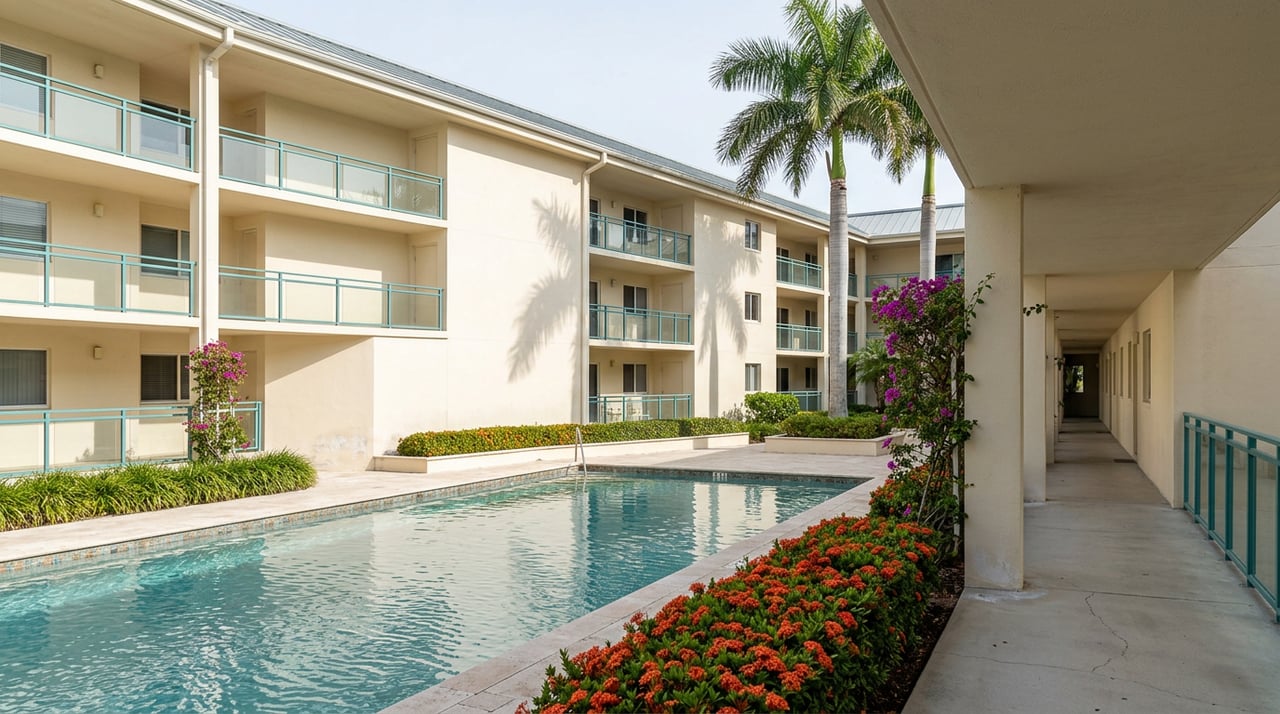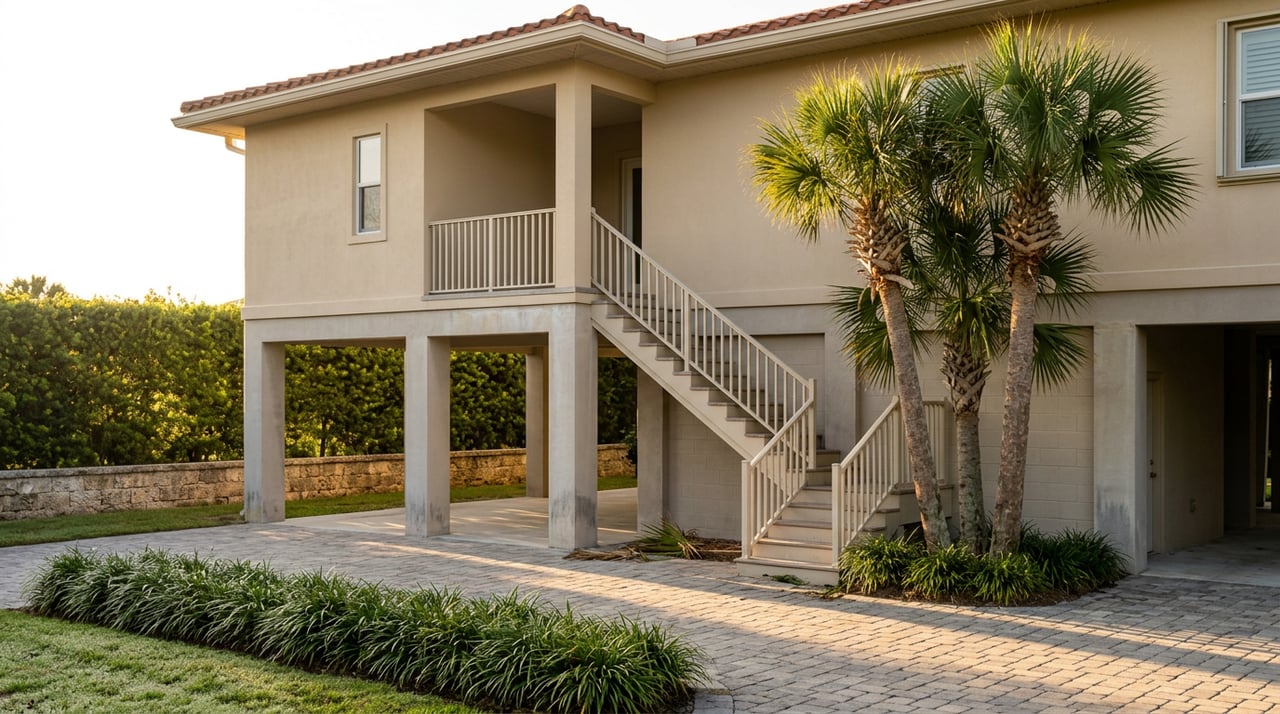
Drive up Gulf of Mexico Drive toward the north end of the Key and you pass it without thinking much about it: a squat, glass-fronted office building at 6960 Gulf of Mexico Drive, sitting empty next to the crowd spilling out of Whitney's patio. It used to be a bank. It hasn't cashed a check since around 2010. For sixteen years it has been the kind of building you stop noticing, the blank space between one thing and the next.
That's about to change, and the way it's changing tells you more about where Longboat Key actually stands two years after Helene and Milton than any reopening announcement has.
What's on the table Tuesday morning
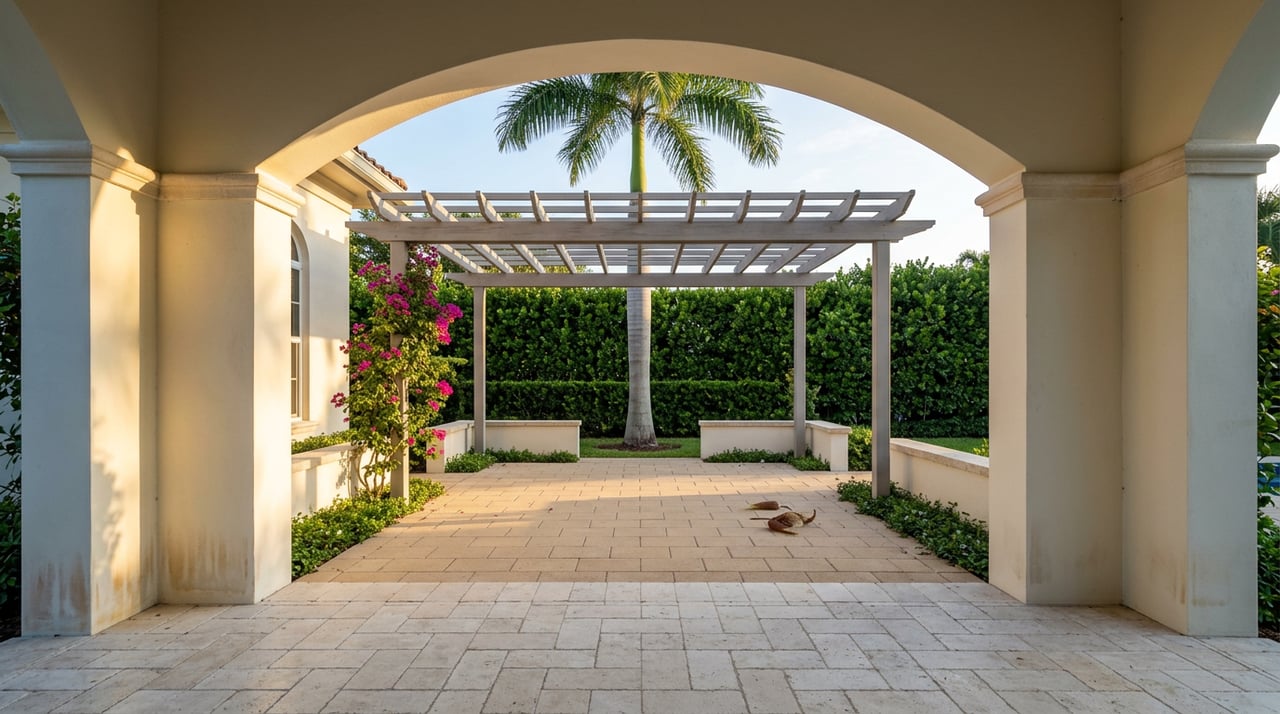
On Tuesday, September 15, the Longboat Key Planning and Zoning Board takes up a two-part application from Whitney LBK LLC, the company that owns and operates Whitney's, the casual seafood spot that's occupied the old Chevron station on the corner of Broadway Street and Gulf of Mexico Drive since it opened in January 2020. The company wants to tear down the vacant bank building next door and turn the land into a tropical outdoor dining garden, along with a new commissary kitchen, storage and cooler space, and restrooms. Renderings show a white pergola shading open-air tables under dense landscaping, with pervious pavers instead of poured concrete. The addition is roughly 2,900 square feet of new dining space, enough to push total capacity toward 200 seats. All the actual cooking stays inside the existing restaurant. The furniture will be portable, the lighting kept low, and no new signage is planned for the dining area.
The hearing starts at 9:15 a.m. at Town Hall on Bay Isles Road, and Town planning staff has already recommended approval. That's not a formality to skip past. The application asks the Town to change both the property's future land use designation and its zoning, from Office-Institutional to Highway-Oriented Commercial, the same classification Whitney's already carries next door. On an island where land use changes can sometimes trigger a voter referendum, this one won't. Neither designation carries residential density under Longboat Key's 1984 Comprehensive Plan, so there's no unit count to fight over, just a business asking permission to feed more people outdoors.
If the board and, later, the Town Commission approve it, Whitney's still isn't finished at Town Hall. The rezone needs two readings, with the second expected sometime in 2027, and the actual site plan with final parking and landscaping comes back for a separate hearing down the road. But the direction is set. One ground rule already spelled out in the application: last call on the new patio will be 10 p.m.
Whitney's own history makes the pitch land. This is a company that already turned one dead property into the north end's most photographed patio once. The original restaurant is built inside a gas station that partners James Brearley, David Benstock, Jose Chichande, and Joseph Chillura gutted and rebuilt rather than tore down, keeping the old canopy and garage doors as part of the design. Chichande grew up on Longboat Key. What they're proposing now is the same move at a bigger scale, on the same block, with a sixteen-year vacant lot instead of an abandoned gas station.
The same Tuesday morning agenda includes two other items worth knowing about if you live here. Sarasota County has an application to amend the Town Center planned development for the new Longboat Key library going in at 600 Bay Isles Road. And the board is holding a workshop on the zoning problems facing homeowners who want to elevate their houses to meet FEMA flood requirements on smaller, non-conforming lots. None of these three items are connected on paper. Together, they read as a single morning where the island is deciding, item by item, what its built environment looks like on the other side of the storms.
The gap between reopening and building
Here's what makes the Whitney's application different from the dozens of hurricane recovery stories that have run out of Longboat Key since the fall of 2024. Reopening a damaged restaurant is a defensive move. Buying the empty lot next door for $1.2 million and asking to double your outdoor capacity is an offensive one. Those are not the same signal, and conflating them misses what's actually happening on this stretch of the island right now.
The recovery itself has been real, and slow. Longboat Key alone absorbed more than $180 million in hurricane damage from Helene and Milton, part of $440 million in damage across Sarasota County. Harry's Continental Kitchens, the longtime restaurant and deli near the Key's north end, took on two and a half feet of water in the restaurant and about four feet in the deli across the street. Hal Christensen of Harry's Continental Kitchens and his staff closed for roughly a month and reopened November 8, 2024, just ahead of the season. The Sandpiper Inn, a 1960s-era hotel at 5451 Gulf of Mexico Drive, took enough damage that owners Harold and Christine Cullison seriously considered selling rather than rebuilding. They rebuilt instead, and didn't officially reopen until August 16, 2025, nearly eleven months after Helene.
That's the texture of most of the recovery coverage out of Longboat Key over the past two years: businesses fighting to get back to where they were. By this spring, the tone had shifted, but only slightly. Longboat Key Club and Resort managing director Rick Konsavage, who has spent 39 years in Southeast hospitality, told local reporters in March that most contractors were finishing up their jobs and the island was finally settling back to normal. He was careful with his optimism, calling it a year that would land "slightly above last year" rather than a banner one. Lazy Lobster owner Michael Garey used almost the same language, describing 2026 as a nice bounce back after a 2025 that saw his business drop roughly 12.5 percent while the island rebuilt around him.
Even that bounce back sits against county numbers that were still soft. Visit Sarasota County recorded 82,900 visitors in November 2025, down 12.5 percent from the year before, and 77,800 in December 2025, down 13.1 percent. Those are not the numbers of a market that's fully healed. They're the numbers of a market that's stabilizing.
A restaurant closing that gap between "stabilizing" and "confident" by spending seven figures on the empty lot next door and asking to nearly double its outdoor footprint is telling you something the visitor counts can't. It's one operator, on one block, betting that the north end's future is bigger than its pre-storm past. The application itself makes that case explicitly, pointing to Mar Vista Dockside and The Shore as proof that well-designed outdoor dining spaces have become genuine destinations on this island, not just places to eat while you're already here.
What to actually watch for
If you live near the Village, the practical timeline is this. The Planning and Zoning Board's recommendation Tuesday goes to the Town Commission, which has to approve both the comprehensive plan change and the rezone across two separate readings before anything can be built, with the second reading expected in 2027. After that, there's still a site plan hearing to nail down parking and the finished landscaping. So the tropical garden you'll eventually walk into isn't opening this season, or maybe even next.
What's worth paying attention to now isn't the timeline. It's the fact that this application exists at all, two years into a recovery that has mostly been measured in what came back, not what got built new. A bank that sat empty for sixteen years is finally getting a second life, and it's getting one because a restaurant two doors down decided the neighborhood was worth betting on before the visitor numbers fully caught up.
That's a different kind of proof than a reopening date. It's the kind that tends to hold up.
If you're curious what shifts like this mean for property values or timing near the Village, Julie Klick has spent 24 years watching this exact stretch of Gulf of Mexico Drive change, one building at a time. Reach out anytime to talk through what's actually happening on your block.